Claire Allen, violin
  • Home
  • Bio
  • Performance
    • Solo Voices Program Notes
  • Studio
    • Student Portal
    • Testimonials
    • Why Study Music?
    • Guide for New Violinists and Parents
  • Media
    • Recordings
  • Blog
  • Contact

Recital Reflection

8/27/2014

0 Comments

 
Picture
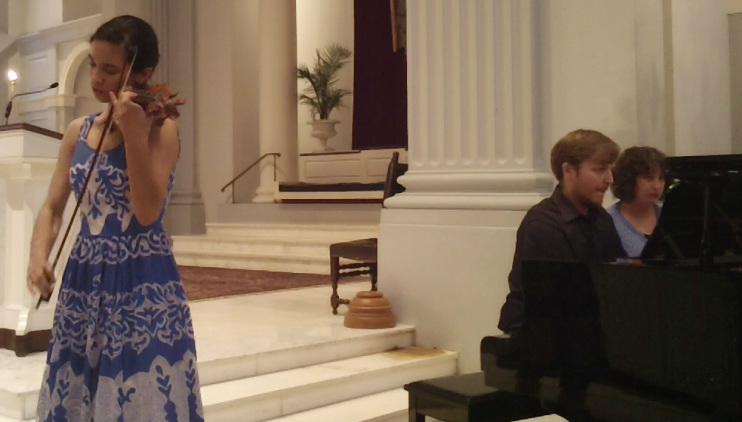
This last month I gave my first full recital since my master's recital back in 2012. Let me say that if I thought performing a recital when it was the center of my life was challenging, preparing and performing this recital while teaching and working was just insane. I woke up early and practiced for a couple of hours before I taught, and then I tried to get another hour in of practice from 9 -10 pm at night, after teaching. I gave up what remained of my weekends to practice. 

I managed a few lessons with a teacher I work with, but not many. I think one of the hardest things about this first year out of school is adjusting to not having weekly violin lessons, because I simply can't afford them with my student loan payments. Last time I gave a recital, I had a lesson every week. I had a ton of rehearsals with my pianist. I had a dress rehearsal in the hall where I was performing, with my teacher there to listen for balance. This time, I had three lessons. I had four rehearsals with my pianist, all of which involved at least an hour of commuting, and I had maybe 45 minutes in the hall right before the recital.

Needless to say, I did not anticipate a lot of these challenges. I got through it, however. I found a new, wonderful collaborator in Wade Meyers, and discovered that I had a capacity for efficient work and beautiful chamber music making that I had almost forgotten.

My primary career right now is as a teacher, and doing this recital reminded me that there are two halves to my musical heart. I love my students more than I knew was possible and thoroughly enjoy discovering each one's strengths and artistic potential. Teaching has helped me treat myself as my own student (and I've discovered that I am both a hard taskmaster and a lazy student, which makes for interesting practice sessions....). But there's another half to my heart, and that's as a performer. I absolutely love performing. I love the adrenaline rush. I love playing music I love for an audience. I love that I can introduce people to the world of classical music and make it come alive for them. 

So, I'm hopeful that there will be more performances coming up this year. I won't necessarily be pursuing a typical performance career track, but I will definitely be putting more of myself and my music out there.

In the meantime, enjoy these recordings from last weekend. There's a Mozart sonata, a Beethoven sonata, and the fourth movement of Lalo's Symphonie Espganole. Just the Lalo is embedded below, but click on related videos to get the rest!
0 Comments

Creating Enthusiastic and Independent Practicers: Toward Independence

8/13/2014

0 Comments

 
This blog series has focused on elements of musical life that can inspire students to be excited about music and more responsible about their practice. How, though, do we get students from parent-directed practice to self-directed practice?
When creating strategies for teaching or for learning, I like to start from my desired end-result and work backwards.

The goal: Students who practice effectively on their own without reminders, who keep track of their own lesson schedules and performances, and who take responsibility for communicating clearly and openly with their teacher.

So, how do we get there?

1. Help the students create identities as violinists, have them take ownership, immerse them in musical culture, and find a musical community for them to participate in so that they are motivated and enthusiastic. My previous entries in this series focus on these steps.   

2. Talk to your private teacher about starting to divide the practice time - have certain things that the child practices alone and certain things for which they still need parental supervision. I recommend starting this between the ages of 8 and 10, depending on the child. For a student who has started to resist parent-directed practice, having the teacher officially appoint the parent as the Watcher Of The Tall Violin or the Curvy Pinky or the Memory Checker can sometimes ease the tension, especially if they know their parent won't be bothering them about other items on their practice list.

3. Alternate days of practice - parent-directed one day, student-directed the next. Gradually reduce the number of days the parent is involved at a pace comfortable for the student until the student is practicing by themselves every day. As the parent-directed practice gets phased out, they can still gently remind the student to practice and assist the student in finding the best time to practice.

4. Make sure to comment positively whenever a student works through a problem on their own, practices without being reminded, or takes initiative in their practice. Parents should ask the students questions to help them identify and solve problems, and praise them when they create a solution. Questions they might ask are, "What did you hear? What did you like? What could be better? Do you think it sounded the same, better, or worse than the last time you played it? What can you do to make it sound more beautiful?" Especially if a student struggles with a difficult concept or task and pushes through, they should be praised for their tenacity. I always try to point this out in my students'  lessons - "I really liked how you heard that the note was out of tune and checked with your open string to find the right intonation - that's a good strategy for fixing that!" If parents and teachers can help students feel confident in their own ability to make progress, they will be much more inclined to practice independently.

5. As the parent pulls back from actively directing the practice, make sure to still let your child know how important their music is to you. Ask them how their practice session went, comment on something you heard that went particularly well, take them to concerts and make sure to attend all their concerts. Check in with them about their relationships with their private teachers, orchestra directors, and chamber coaches to make sure they're still in the best learning environment for them.

6. Around the ages of 12 - 13, the parent should stop sitting in on the lessons with their child. The student is now responsible for taking notes during the lesson. This is where video recording the lesson can be a wonderful tool, as the student becomes accustomed to taking notes and learning what is important to remember. This can be a gradual transition, again - one lesson with the parent, one lesson without. It will depend on the student and on the parent. Some may be able to go cold turkey, while others may need a slower rate of change.

7. Once the student is in high school, they should assume responsibility for all communications with their teacher. If they have a scheduling conflict and need to find a time for a makeup, they should be the one to email their teacher - not the parent (although it is good to always copy the parent on emails so everyone is on the same page). At this point, parents should not attend the lesson at all. 

8. Keep in mind that even teenagers frequently have to be reminded to clean up after themselves and to do their homework - it's natural that students of all ages will still need to be reminded to practice from time to time, and that is okay. However, if the student never wants to practice, it's time for some extra motivation and it can be good for the parent to check in with the teacher to see what strategies can be employed.

I started this blog series because I frequently get questions from parents about how to get their kids to practice and they inspired me to sit down and really think about what does motivate someone to practice. I hope you've found some useful tips in this series. Please comment and let me know how these suggestions are impacting your practice - or let me know of other strategies you've used to motivate your students!

Thanks for reading!
0 Comments

Creating Enthusiastic and Independent Practicers: The Importance of Community

8/12/2014

0 Comments

 
Despite the hours of individual practice required, music isn't actually an individual, solitary activity. There are very few concerts where there is just one performer! Not to mention that humans are naturally social creatures - we like to do things with our friends! Having a community of violin friends can be highly motivational and really fun for students of any age. Here are some tips to make sure you're getting the best communal violin experience possible.

1. Participate in recitals. Performing for your peers and being there to support them when they perform is a wonderful way to start building community. Make sure the recital is your priority that day so you can stay for the whole recital and also spend time socializing with your friends afterwards.

2. Take advantage of studio classes or group classes. Busy families sometimes choose to forego the group classes - a private lesson once a week is all they can manage schedule and budget-wise. These students sometimes suffer from isolation. They aren't around other people their own age who are playing the violin, and violin is just something they do by themselves. Consequently, they're less motivated practicers and less enthusiastic about violin in general. My students who participate in group and studio classes, however, ask me frequently about their friends in the studio, practice eagerly so they can play with their fellow students, and give more confident performances because of their comfort in front of an audience. These group experiences create positive peer pressure. It's also wonderful for parents, because they see that they are not alone in trying to convince their children to practice and they create their own community.

3. Invite your violin friends over for playdates - with their instruments.  Let them play whatever they want together, with no parent direction. This helps reinforce the message that violin is fun, and interactive. It can be a great way to balance out more focused, parent-directed practice sessions.

4. Go to concerts. It's very cool for kids to go to a concert and be able to say, "I play violin too!" Or even, "Someday, that will be me up there!" This is also a great family activity or even a good play date activity. In the DC area, where I live and teach, there are countless concert opportunities every weekend - many of them free! This is a wonderful way to connect to the larger music community.

5. Play in an orchestra or a chamber group. Whether you're a 10 year old looking for more friends at school or an adult looking to connect with other musical amateurs, playing in an orchestra or a chamber group can greatly enhance your musical life. Learning to play with others as part of a team is an invaluable experience - and also great practice motivation. It's one thing to miss a day of practice and only have your own playing to worry about. It's another thing to not practice routinely and have that let your group down. And once again, it's fun. Connecting with like-minded peers is essential for musical growth and development, and playing in an ensemble gives you that experience.

Stay tuned for the last post in this series: Towards Complete Independence.
0 Comments
    Picture

    Claire Allen

    Written thoughts on my musical life.

    Archives

    December 2024
    September 2022
    February 2019
    January 2019
    December 2018
    May 2018
    April 2018
    January 2018
    December 2017
    July 2016
    June 2016
    May 2016
    April 2016
    October 2015
    September 2015
    August 2015
    July 2015
    June 2015
    March 2015
    February 2015
    January 2015
    December 2014
    November 2014
    October 2014
    September 2014
    August 2014
    July 2014
    June 2014
    May 2014
    April 2014
    March 2014
    February 2014
    January 2014
    December 2013
    November 2013
    October 2013
    September 2013
    August 2013
    July 2013
    June 2013
    January 2013
    December 2012
    November 2012
    September 2012
    August 2012
    July 2012
    May 2012

    RSS Feed

    Categories

    All
    Classical Music
    Music Lessons
    Perpetual Motion
    Practice Tips
    Practicing
    Summer Violin
    Suzuki Violin
    Tips For Parents
    Tips For Students
    Violin Camp
    Violin Lessons
    Violin Philosophy
    Virginia Summer Music Camp

© Claire Allen 2025