Today, I'm going to tackle one of the great debates in the violin world: the shoulder rest. Whether to use a shoulder rest, a sponge, a cloth, or nothing is an incredibly personal choice. It's something that inspires heated and sometimes nasty debates between violinists.
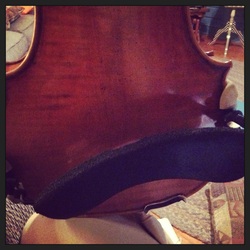
In my own playing, I've switched my setup many times. For many years, I used a Wolf Forte Primo, and after about 3 years switched to the Wolf Forte Secondo, shown at left.
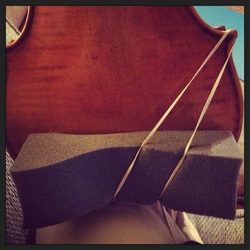
During my last semester of graduate school, during a particularly intense orchestral rotation, I started having some intense pain in my left shoulder. Having been through a repetitive strain injury before, I had no desire to repeat it. I had been thinking about making a change to a shoulder rest free setup for some time, since my own teacher used nothing and my Paul Rolland-influenced pedagogy professor also taught a shoulder rest free way of playing. However, in the middle of such a busy playing schedule, I wasn't able to take the time I needed to make such a dramatic change, which would have required major adjustments to every aspect of my technique. I used this contoured sponge, pictured at right, as a wonderful transition step. My shoulder pain went away in a day. This contoured sponge provided wonderful support while not restricting my shoulder in any way.
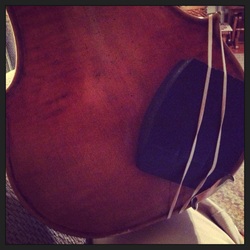
Last month, I attended a pedagogy workshop at Indiana University led by Mimi Zweig. Mimi greatly believes in not using a shoulder rest. I was curious, so I took off even the contoured sponge. I was amazed at how much more connected I felt to my instrument.
I've struggled throughout the years with many tension problems in my playing. Thanks to some wonderful teachers, I've made great progress. However, making this dramatic change to my setup is forcing me to relate to my body in a different way and has transformed my sound in many positive ways.
I'm now using a Huber shoulder pad - not for support, but to help keep the violin from slipping.
I've struggled throughout the years with many tension problems in my playing. Thanks to some wonderful teachers, I've made great progress. However, making this dramatic change to my setup is forcing me to relate to my body in a different way and has transformed my sound in many positive ways.
I'm now using a Huber shoulder pad - not for support, but to help keep the violin from slipping.
| Arguments For Using A Shoulder Rest 1. It provides support and makes the instrument easier to hold. 2. It frees up the left hand. 3. The shoulder rest can enhance the resonance of the instrument and make the sound better. | Arguments For Not Using A Shoulder Rest 1. In the absence of a shoulder rest, the ball and socket joint of the shoulder can swing freely under the instrument. 2. The player must really know how to balance the instrument between their collarbone and hand. 3. The natural weight of the instrument works with the body of the player to create a more organic and effortless playing technique. 4. The tone of the violin is freer without anything dampening the vibrations. |
I think it's important for everyone to realize that there is not only one right way to set up the violin. It may take several configurations before you find out what's right for you. Teachers have a tendency to teach the way they play, so a teacher who uses a shoulder rest may not be familiar with the techniques used in playing without one, and vice versa. I was fortunate to have teachers in both schools of thought over the years.
In your search for the right setup, it's important to be honest and open with your teacher. Your teacher, as amazing as they are, is not you. They are not in your body, holding your violin and experiencing it the way you are. It's critical that as you experiment with different setups that you tell your teacher how it feels to you - what feels like it's working, what feels uncomfortable, etc.
There have been many great violinists throughout the years who have played with all different kinds of setups. Let's take a look at four of them.
The violinist Nathan Milstein played with no shoulder rest at all. Take a listen to his gorgeous performance of the Beethoven Kreutzer Sonata - which, by the way, he performed on his very last public recital along with the Bach Chaconne when he was in his early eighties.
In your search for the right setup, it's important to be honest and open with your teacher. Your teacher, as amazing as they are, is not you. They are not in your body, holding your violin and experiencing it the way you are. It's critical that as you experiment with different setups that you tell your teacher how it feels to you - what feels like it's working, what feels uncomfortable, etc.
There have been many great violinists throughout the years who have played with all different kinds of setups. Let's take a look at four of them.
The violinist Nathan Milstein played with no shoulder rest at all. Take a listen to his gorgeous performance of the Beethoven Kreutzer Sonata - which, by the way, he performed on his very last public recital along with the Bach Chaconne when he was in his early eighties.
Gil Shaham, a soloist currently active today, is shown below playing Sarasate's Carmen Fantasy. He is using a shoulder rest - the camera angle doesn't allow me to see which model it is, but you can see that he is playing beautifully, and with a shoulder rest.
Anne-Sophie Mutter, another modern soloist, plays with no shoulder rest, no pad, no cloth, and on a bare shoulder. Nathan Milstein was wearing a suit and possibly could have had a pad under his jacket. Not so here - this violinist has found a way to completely balance her instrument without any additional aid.
And finally, the violinist Midori is shown playing here with a shoulder rest and a cloth over her chin rest for additional comfort.
In conclusion, there is no universal "right way" of supporting the violin. It's essential for all of us, as teachers and players, to keep an open mind. What could be uncomfortable and even painful for one of us might be a perfect and healthy fit for someone else. It's part of each violinist's unique journey to physical freedom while playing their instrument.
 RSS Feed